American Slavery and the Atlantic Slave Trade
Welcome to a study of the history of slavery in the American South and the Atlantic Slave Trade. Using pictures, maps, video and more, visitors will explore the impact of slavery on economies and peoples around the world.
Essential Inquiry Question
In what ways was slavery significant for the development of the American colonies?
Timeline of Important Events
Explore the key moments across four centuries of the Transatlantic Slave Trade
Portuguese sailors capture the first African captives from the West African coast, beginning the European slave trade.
First enslaved Africans are transported directly from Africa to the Spanish colonies in the Americas.
First enslaved Africans arrive in the English colony of Virginia (Jamestown), marking the beginning of slavery in what would become the United States.
The peak century of the Transatlantic Slave Trade. Over 6 million Africans are forcibly transported across the Atlantic.
Britain and the United States abolish the international slave trade (though slavery itself continues for decades).
The Slavery Abolition Act ends slavery in most of the British Empire.
The 13th Amendment to the U.S. Constitution formally abolishes slavery in the United States after the Civil War.
Explore the Pages
Page 1
Plantations — Tobacco, Rice, Sugar Cane & Cotton
Page 2
Reasons for Using Slave Labour
Page 3
Capture, Sale & Transport from West Africa
Page 4
Slave Markets
Page 5
Numbers of Slaves Taken to America
Page 6
What Happened to the Raw Materials?
📖 Image Source Reference — Click to expand
The images used in this website are local files from the project folder. Below is the mapping between the requested image filenames and the actual files used:
| Requested Filename | Actual File Used | Page(s) |
|---|---|---|
tobacco_field.jpg |
slavespickingleaves.jpg |
Page 1 — Tobacco |
rice_cultivation.jpg |
slavesworking.jpg |
Page 1 — Rice |
sugar_cane_harvest.png |
slaves wrking.jpg |
Page 1 — Sugar Cane |
cotton_plantation.jpg |
slaves picking cotton.jpg |
Page 1 — Cotton |
middle_passage_map.png |
slave trade routes.jpg |
Page 3 |
slave_ship_diagram.jpg |
ship for slaves.jpg |
Page 3 |
slave_market_notice.png |
slvaes for sale poster.jpg |
Page 4 |
triangular_trade_route.png |
triangular trade routes.jpg |
Page 6 |
Note: Some requested filenames differ from the actual local files. The closest matching images were used.
Plantations — Tobacco, Rice, Sugar Cane & Cotton
Plantations were massive commercial farms that grew crops for profit. They were the backbone of the colonial economy — and they relied entirely on the forced labour of enslaved people.
A plantation was not just a farm. It was a large estate, often covering hundreds or even thousands of acres, where a single cash crop was grown to be sold for profit in markets far away. These crops were called "cash crops" because they were grown to make money, not just to feed the people on the plantation.
By the 1700s, plantations stretched across the American South, the Caribbean Islands, and parts of South America. The four most important cash crops were tobacco, rice, sugar cane, and cotton. Each required huge numbers of workers to plant, tend, and harvest. European colonists turned to the enslavement of Africans to meet this demand.
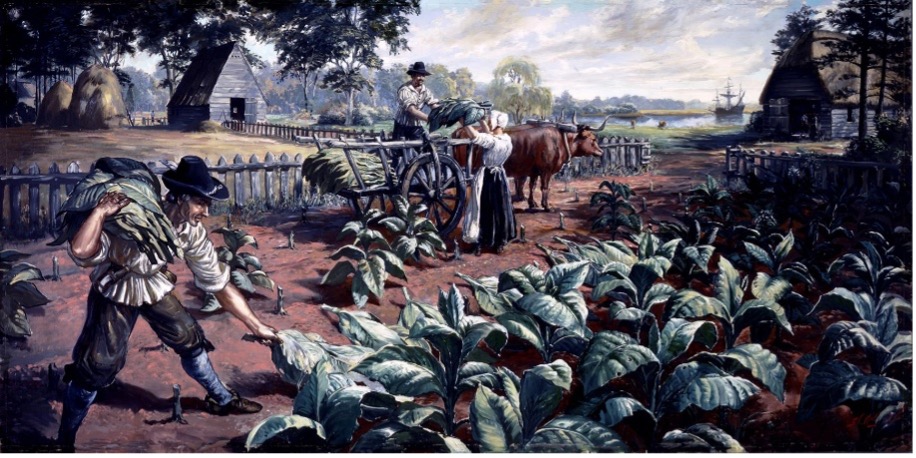
Tobacco
Tobacco was the first major cash crop of the American colonies. Grown mainly in Virginia and Maryland, it was highly profitable in Europe where smoking had become fashionable. Tobacco plants required constant care — from planting seedlings to removing worms by hand — meaning workers toiled in the fields year-round. By the 1700s, tobacco was the most valuable export from the American colonies.
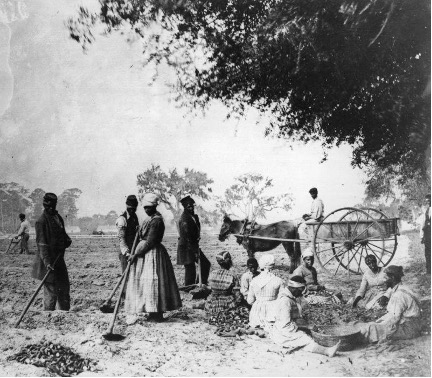
Rice
Rice was grown in the swampy coastal regions of South Carolina and Georgia. It was back-breaking work: enslaved people stood in water for hours under the hot sun, planting and weeding the crop. Many enslaved Africans brought knowledge of rice cultivation from West Africa, where rice had been grown for centuries. Despite this expertise, they were forced to work under brutal conditions with little rest.
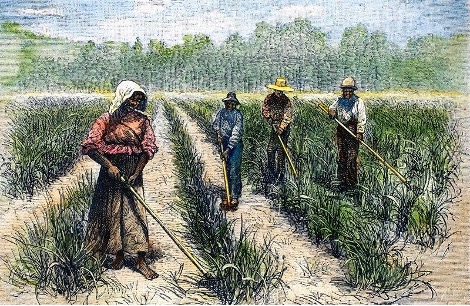
Sugar Cane
Sugar cane was the most profitable but most brutal of all plantation crops. Grown in the Caribbean islands (Barbados, Jamaica, Haiti) and parts of South America, sugar required harvesting during the hottest months and processing immediately in dangerous mills. The combination of intense heat, sharp cane knives, and heavy machinery led to terrible injuries. The demand for sugar in Europe drove the slave trade to its peak.
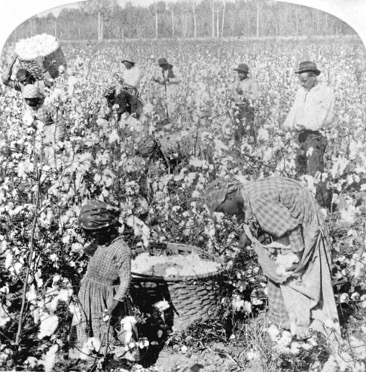
Cotton
After the invention of the cotton gin in 1793, cotton became the most important crop in the American South. The cotton gin made it faster to remove seeds from cotton fibres, but it also increased the demand for enslaved labour to grow more cotton. Huge plantations spread across Georgia, Alabama, Mississippi, and Louisiana. Enslaved people would pick cotton from dawn to dusk, filling heavy sacks as they moved down long rows under the scorching sun.
Match the Crop to the Region & Conditions
Read the four crop descriptions above and think like a historian. Answer the following questions in your notebook or discuss with a partner:
- Which crop required workers to stand in swampy water for hours, and in which American colonies was it grown?
- Why do you think sugar cane plantations were considered the most brutal? Identify at least three reasons from the text.
- Think critically: In the tobacco section, it says work was needed "year-round." What does that tell you about the lives of enslaved people on a tobacco plantation? How much rest or freedom do you think they had?
- Historical reasoning: How did the invention of the cotton gin actually increase rather than decrease the number of enslaved people in the American South? This seems like a puzzle — explain the logic.
Pro Tip: Look at the images provided for each crop. What do you notice about the working conditions? What details stand out to you?
Reasons for Using Slave Labour
Why did European settlers turn to enslaved Africans instead of using other forms of labour? The answer lies in economics, power, and profit.
The Search for Cheap Labour
When European colonists first arrived in the Americas, they needed workers to build settlements, clear land, and grow crops. At first, they tried using Indigenous peoples as forced labour. However, millions of Indigenous people died from European diseases (like smallpox and measles) to which they had no immunity. Those who survived often escaped because they knew the land well.
From Indentured Servants to Enslaved Africans
Next, colonists brought over indentured servants from Europe. These were poor people who agreed to work for a set number of years (usually 4–7) in exchange for passage to America, food, and shelter. However, indentured servants had rights. They could not be worked to death, and at the end of their contract, they were freed — and sometimes even given land. This made them a temporary and expensive solution.
Colonists needed a labour force that was:
- Permanent — workers who would not gain freedom after a few years
- Cheap — a one-time purchase with no ongoing wages
- Controllable — people who could be kept in bondage by law and force
- Renewable — children born to enslaved people would also be enslaved
The Calculation of Profit
Slavery was not just a cruel choice — it was a calculated economic decision. Plantation owners calculated that buying an enslaved person was cheaper over a lifetime than paying wages to a free worker. The slave trade also created huge profits for ship owners, merchants, and investors in Europe and the Americas. An entire economy grew around the buying and selling of human beings.
Racial Ideology as Justification
To make slavery acceptable, Europeans developed racist ideas that claimed African people were inferior and suited for forced labour. These false beliefs were taught in schools, churches, and laws. Over time, slavery became tied to skin colour — with Africans and their descendants enslaved, while white Europeans remained free. This racial division was deliberately created to divide poor white and black workers and prevent them from uniting against the wealthy plantation owners.
Analyze the Economic Motivations
Read the following adapted primary source and answer the questions below.
"It is not profitable to employ free men for plantation work... The planter who buys a negro [enslaved person] purchases a worker for life. While the free labourer must be paid wages each year, the enslaved worker costs only food and clothing. The profit is clear."
— Adapted from writings of an 18th-century Caribbean plantation owner
- Summarize the main argument this plantation owner makes in your own words. What is his key justification for slavery?
- Identify two groups of people the colonists tried using for labour before turning to enslaved Africans. Why did each group not work out for the colonists?
- Critical thinking: The text says racial ideology was "deliberately created." Why would wealthy plantation owners want to divide poor white workers and enslaved black workers? What might happen if these groups united?
- Empathetic reflection: Imagine you are an enslaved person working on a plantation from sunrise to sunset, while the plantation owner grows rich from your labour. Write two sentences describing how you would feel about the idea that this is "profitable" for him.
How Slaves Were Captured, Sold, and Transported from West Africa
The journey from freedom to enslavement was a series of increasingly horrific experiences. This page traces that journey with historical accuracy and respect for the millions who endured it.
Capture in West Africa
The vast majority of enslaved people came from West Africa — the region that today includes countries like Senegal, Ghana, Nigeria, Angola, and the Ivory Coast. Africans were captured through several methods:
- Warfare: European traders encouraged African kingdoms to go to war with their neighbours. The winners would sell captives to European slave traders in exchange for guns, alcohol, and textiles.
- Raids: Armed groups would attack villages at night, burning homes and capturing people as they tried to flee.
- Kidnapping: Individuals were sometimes kidnapped by slave raiders while travelling, farming, or fetching water.
- Judicial punishment: Some African legal systems allowed people convicted of crimes to be sold into slavery.
The Journey to the Coast
After capture, enslaved people were forced to march for weeks or even months to reach the coast. They were tied together with wooden yokes around their necks or ropes around their wrists. Those who could not keep up were beaten or killed. Many died from exhaustion, hunger, or disease along the way. When they reached the coast, they were held in slave dungeons — dark, cramped stone cells with little air or sanitation.
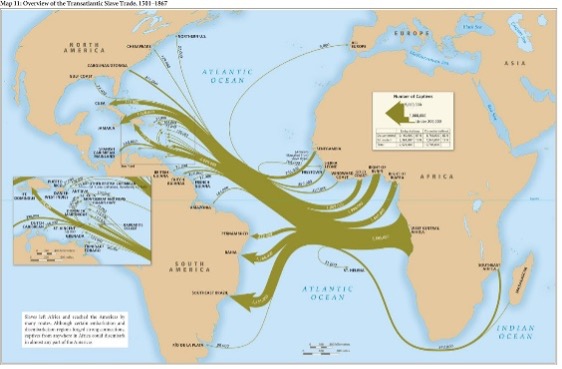
The Middle Passage: The journey from Africa to the Americas across the Atlantic Ocean

Slave dungeons — holding cells on the coast of West Africa where captives awaited the ships
The Middle Passage
The Middle Passage was the journey across the Atlantic Ocean from Africa to the Americas. It was a nightmare of human suffering that lasted anywhere from 3 weeks to 3 months, depending on the weather and the ship.
Enslaved people were packed into the hold (cargo area) of the ship, lying on bare wooden shelves stacked so close together that they could barely move. There was not enough room to sit upright. The conditions were:
- Extreme crowding: Men were chained together in pairs at the ankles and wrists. Women and children were kept in separate sections but also tightly packed.
- Disease: Dysentery, smallpox, and fevers spread rapidly in the filthy, cramped conditions.
- Lack of food and water: Captives received minimal rations — often just water and a small portion of rice or beans once a day.
- Brutal punishment: Anyone who tried to rebel or resist was severely whipped, tortured, or thrown overboard.
On average, about 15-20% of captives died during the Middle Passage. Some ships lost over half of their human cargo before reaching the Americas.
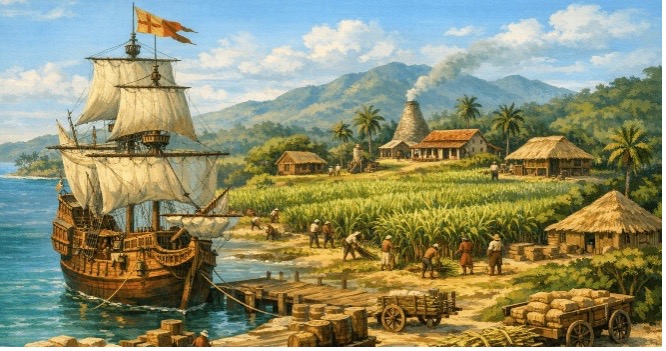
Diagram of a slave ship — this is the famous "Brookes" diagram that showed how enslaved people were packed into the hold
Analyze the Slave Ship Diagram
Carefully examine the slave ship diagram to the left. This drawing was used by abolitionists to show the public the horrors of the slave trade.
- Describe what you see. How many people are packed into each section? What is the spacing between the shelves?
- Calculate: If each adult needed about 6 feet of length and 18 inches of width to lie down, could the people in this diagram lie flat? What does this tell you?
- Infer: What health problems would arise from being packed this tightly for weeks with limited food, water, and no sanitation?
- Emotional response: The diagram was published to make people feel outrage. In your own words, explain why looking at this image would have made people in the 1700s want to end the slave trade.
Slave Markets
When the slave ships arrived in the Americas, the nightmare did not end. Survivors faced the degradation of the slave market, where human beings were inspected, priced, and sold like property.
Arrival in the Americas
After surviving the Middle Passage, enslaved people who were still alive were brought onto the deck of the ship. They were washed, rubbed with oil to make their skin appear healthier, and given a small amount of food. These preparations were not done out of kindness — they were done to make captives look healthier so they would sell for a higher price.
The Auction Block
Enslaved people were sold in public markets in cities like Charleston, Richmond, New Orleans, and Bridgetown (Barbados). The process was deeply dehumanizing:
- Inspection: Buyers would examine enslaved people like livestock. They checked teeth, muscles, and skin. They poked and prodded to look for signs of disease or weakness.
- Scrambles: Sometimes enslaved people were sold in "scrambles" — buyers would throw money at the auctioneer and then rush into a pen to grab the people they wanted.
- Families torn apart: Husbands were separated from wives, and parents were separated from children. This was one of the most cruel aspects of the slave trade — families were deliberately broken up because individual family members sold for more money than a family group.
- Pricing: Young, strong men sold for the highest prices because they could do the heaviest labour. Women of childbearing age also sold well because their children would become the property of the owner.
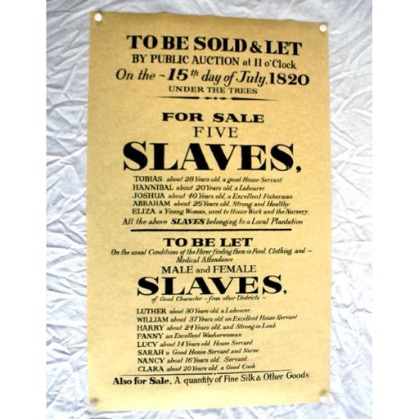
Slave market poster — notices like these were printed to advertise upcoming auctions of enslaved people
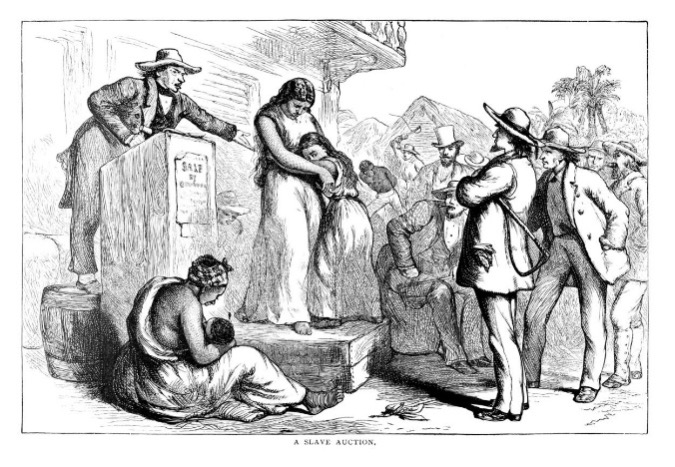
An auction of enslaved people in the American South — families were often separated at these events
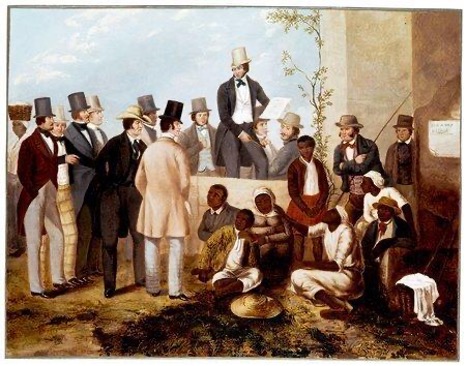
Buyers inspecting and bidding on enslaved people at a public auction
Analyze the Slave Market Notice
Examine the slave market poster image above. This is a primary source — an actual historical document from the time of slavery.
- List all the information the poster gives about the people being sold. What does it say about their ages, skills, or conditions?
- Notice the language: Look at the words used to describe the enslaved people. Are they described as human beings or as products? Give an example.
- Critical question: The poster says a woman is sold "with her child." Why do you think this detail was mentioned? What does this tell us about how enslaved children were valued?
- Think deeper: Imagine the people listed on this poster had names, families, and life stories. What information is missing from this poster that would tell their full story as human beings?
Numbers of Slaves Taken to America
The Transatlantic Slave Trade lasted over 400 years and involved the forced migration of millions of African people. The numbers help us understand the massive scale of this tragedy.
Total Numbers at a Glance
Historians estimate that between 12 and 15 million African people were transported across the Atlantic Ocean during the Transatlantic Slave Trade. Of these, approximately 10 to 12 million survived the Middle Passage and arrived in the Americas. The remaining 2 to 3 million died during the journey.
By Century: When Did the Trade Peak?
Number of Africans transported across the Atlantic by century
Hover over each bar to see the exact number. Source: Slave Voyages Database
Where Did Enslaved Africans Go?
The majority of enslaved Africans were sent to the Caribbean and South America, not to what is now the United States. Here is the breakdown by destination:
- Caribbean Islands (British, French, Spanish, Dutch): ~5 million — mainly to work on sugar plantations
- South America (especially Brazil): ~4.9 million — mainly to work on sugar and coffee plantations, and in gold mines
- British North America (USA): ~450,000 — only about 4% of the total
- Other regions: ~300,000 — to Central America, Europe, and other islands
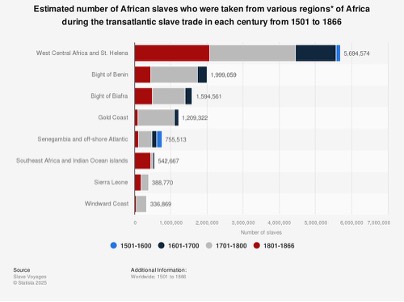
Historical chart documenting the estimated numbers of enslaved people taken from various regions of Africa
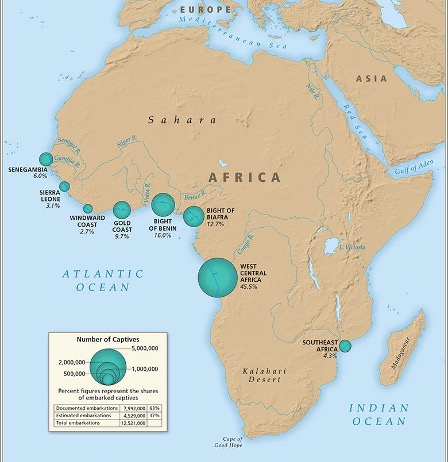
Map of Africa showing regions of origin and numbers of captives taken from each area
Reading the Numbers: A Data Interpretation Exercise
Look closely at the bar chart and statistics above to answer these questions.
- Which century saw the largest number of enslaved Africans transported across the Atlantic? Approximately how many people were taken during this century?
- Compare: How many more people were taken in the 1700s compared to the 1600s? Show your calculation.
- Surprising fact: Only about 4% of all enslaved Africans went to what is now the United States. Where did the other 96% go? Why do you think so many people were sent to the Caribbean and Brazil instead?
- Think about scale: The total number of people transported (12.5 million) is larger than the population of many countries today. Name a city or country you know of that has a similar population. How does this comparison help you understand the scale of the slave trade?
- Reflection: Each number in this chart represents a real person with a name, a family, and a life story. Write one sentence acknowledging what these statistics mean beyond just numbers.
What Happened to the Raw Materials That Slaves Produced?
The plantation system did not exist in isolation. It was part of a vast global economic network called the Triangular Trade that connected Africa, the Americas, and Europe.
The Triangular Trade
The Triangular Trade describes the three-legged journey that ships made across the Atlantic, carrying different cargo on each leg. It was called "triangular" because the routes formed a rough triangle on the map.
The Three Legs of the Triangular Trade
Leg 1: Europe → Africa
European ships carried manufactured goods such as guns, gunpowder, textiles, alcohol, and beads. These goods were traded for enslaved Africans.
Leg 2: Africa → Americas
This was the Middle Passage. Enslaved Africans were transported across the Atlantic to be sold and forced to work on plantations.
Leg 3: Americas → Europe
Ships returned to Europe carrying raw materials produced by enslaved labour: cotton, sugar, tobacco, rice, and indigo (a blue dye).
What Happened to the Raw Materials?
The raw materials produced on plantations did not stay in the Americas. They were shipped to Europe and New England, where they fuelled a growing industrial economy:
Cotton
Cotton was shipped to textile mills in Britain (Manchester, Liverpool) and New England. There, it was woven into cloth in factories. The Industrial Revolution in Britain was powered in large part by cotton grown by enslaved people in America.
Sugar
Sugar was refined in European ports and sold across the continent. It became a staple in European diets — in tea, coffee, cakes, and sweets. The sugar trade created enormous wealth for port cities like Bristol, Liverpool, and Nantes.
Tobacco
Tobacco was shipped to Europe where smoking became widely popular. Governments collected huge taxes on tobacco sales, funding their armies and governments with profits built on enslaved labour.
Rice & Indigo
Rice was sold as food across Europe and the Americas. Indigo was used to produce blue dye for the growing textile industry. Both crops created additional wealth from the labour of enslaved people.
The Triangular Trade: A Complete Economic Loop
The Triangular Trade created a self-reinforcing economic system:
- European guns were traded for African captives
- African captives were forced to grow raw materials in the Americas
- Raw materials were shipped to Europe to be turned into manufactured goods
- Manufactured goods (including more guns) were shipped back to Africa to trade for more captives
- The cycle continued, generating enormous profits at every stage — except for the enslaved people at the centre of it all.
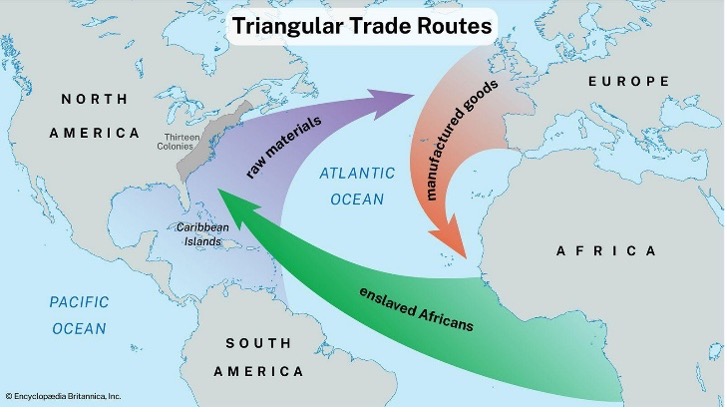
The Triangular Trade routes: Europe → Africa → Americas → Europe
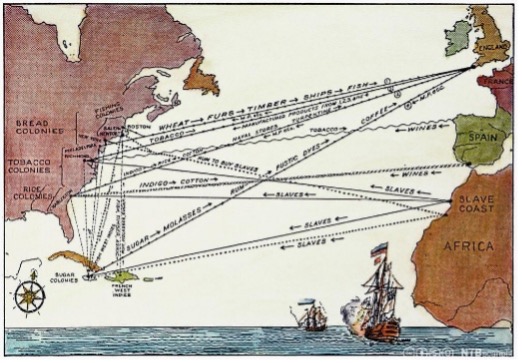
Detailed map illustrating the complex trade networks of the Atlantic slave trade
Trace the Triangular Trade
Use the triangular trade route map above to complete this activity.
- Identify the three regions connected by the triangular trade. Label them on your own map or list them in order.
- Name what was carried on each leg of the journey:
- From Europe to Africa:
- From Africa to the Americas:
- From the Americas to Europe:
- Explain how the Triangular Trade was a "self-reinforcing economic loop." What product from Europe was especially important in keeping the cycle going?
- Think critically: European countries grew enormously wealthy from the Triangular Trade. What do you think happened to the economies of West African kingdoms that sold people into slavery? Did they also gain lasting wealth?
- Create: Draw a simple diagram showing the Triangular Trade. Use arrows to show the direction of each leg and label the cargo carried. Include a short caption explaining how enslaved people were at the centre of this system.
You Have Completed All 6 Pages
Now think back to the Essential Inquiry Question:
Using evidence from all six pages, write a paragraph answering this question. Include specific examples from the crops, the labour system, the trade routes, and the statistics you have studied.
↑ Return to Home Page